
Why the roofs pray: snow, silkworms, gunpowder, and a village that helps its own
The short version: every part of a gassho-zukuri house is an answer to this valley — deep snow, little flat land, and winters cut off from the world. Read the house, and you read how people survived here.
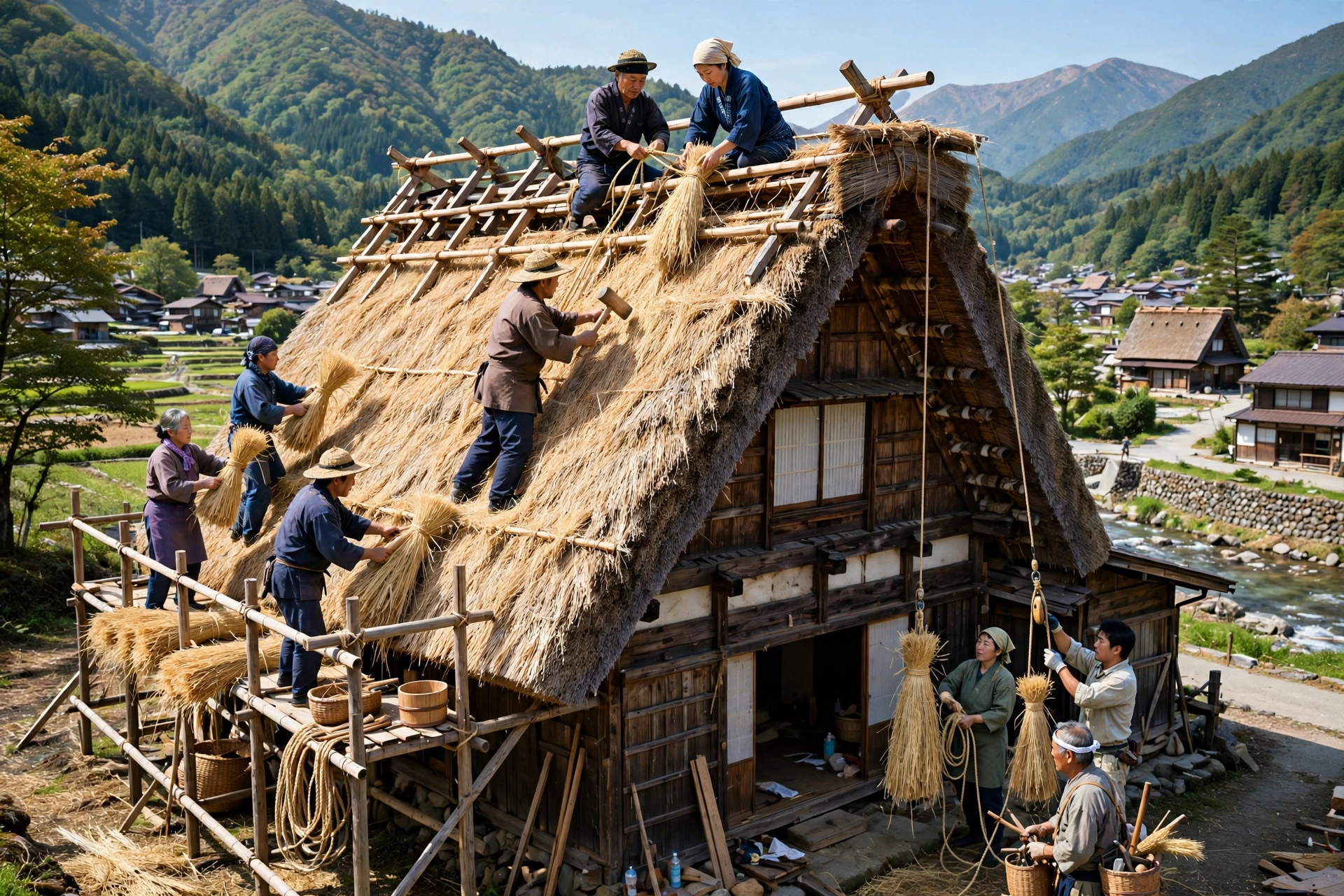
A roof like praying hands
Gassho means hands pressed together in prayer. The roofs rise at roughly 60 degrees so that snow — two or three metres of it in a hard winter — slides off instead of crushing the house.
The roof frame uses no nails at all: great logs are set into the beams below and lashed together with straw rope and neso, bindings twisted from young witch-hazel branches. The frame can flex under the weight of snow and in earthquakes, and it has held for more than two centuries.
Silkworms in the attic
From the late Edo period, silk was the valley's money. Silkworms need warm, dry, spacious rooms, so families floored the inside of that great roof at two, three or four levels and raised silkworms in the attic, warmed by smoke rising from the hearth below.
The wide paper windows in the gable ends let in light for the work. Most of the houses standing today were built in the 1800s and early 1900s, as the silk trade grew. You can still see the attic floors and tools inside the Wada, Kanda and Nagase houses.
Gunpowder under the floor
The second income was quieter. In pits dug under the floorboards, families mixed soil with plants such as mugwort and left it for years to produce saltpeter — an essential ingredient of gunpowder, valuable to the Kaga domain that ruled here. At the Kanda House, the old production pit is still there to see.
Yui: one roof, one village
Thatch does not last forever. Replacing a roof takes far more hands than one family has, so the village developed yui — a system of mutual labour in which everyone turns out to re-thatch one house at a time. The oldest record of a yui re-thatching dates to 1792.
Today, more than a hundred villagers still climb onto a single roof together. The Shirakawa-go Tourist Association explains that this spirit of mutual assistance is part of what UNESCO recognised in 1995 — not only the buildings and the landscape, but the way of life that keeps them standing.
Not to be sold, not to be rented, not to be destroyed
In the postwar decades, dams and modern life emptied many houses. In 1971 the residents of Ogimachi formed a preservation society with three rules for the gassho houses: they must not be sold, rented out, or demolished.
In 1976 the village became a nationally designated preservation district, and in 1995 — together with Ainokura and Suganuma in neighbouring Gokayama — it was inscribed as a UNESCO World Heritage Site, the Historic Villages of Shirakawa-go and Gokayama.
A festival taste: doburoku
Each autumn, Shirakawa Hachiman Shrine holds its Doburoku Festival, offering cloudy, unrefined sake to the gods. It is the valley's great harvest celebration — and a reminder that this heritage is a living calendar, not a display.