
Travel Manners in Japan: Not a List of Bans — a Way of Joining In
Japanese manners are not a test, and nobody expects you to pass one. Almost every custom on this page comes from a single idea — **do not make trouble for the people around you**. If you are not sure, watch the people nearby, or just ask. Asking is never rude here, and it costs nothing: people will often point the way, and sometimes walk with you to show you. A small bow, a quiet voice, and a genuine *arigato gozaimasu* (thank you) will carry you through almost everything.
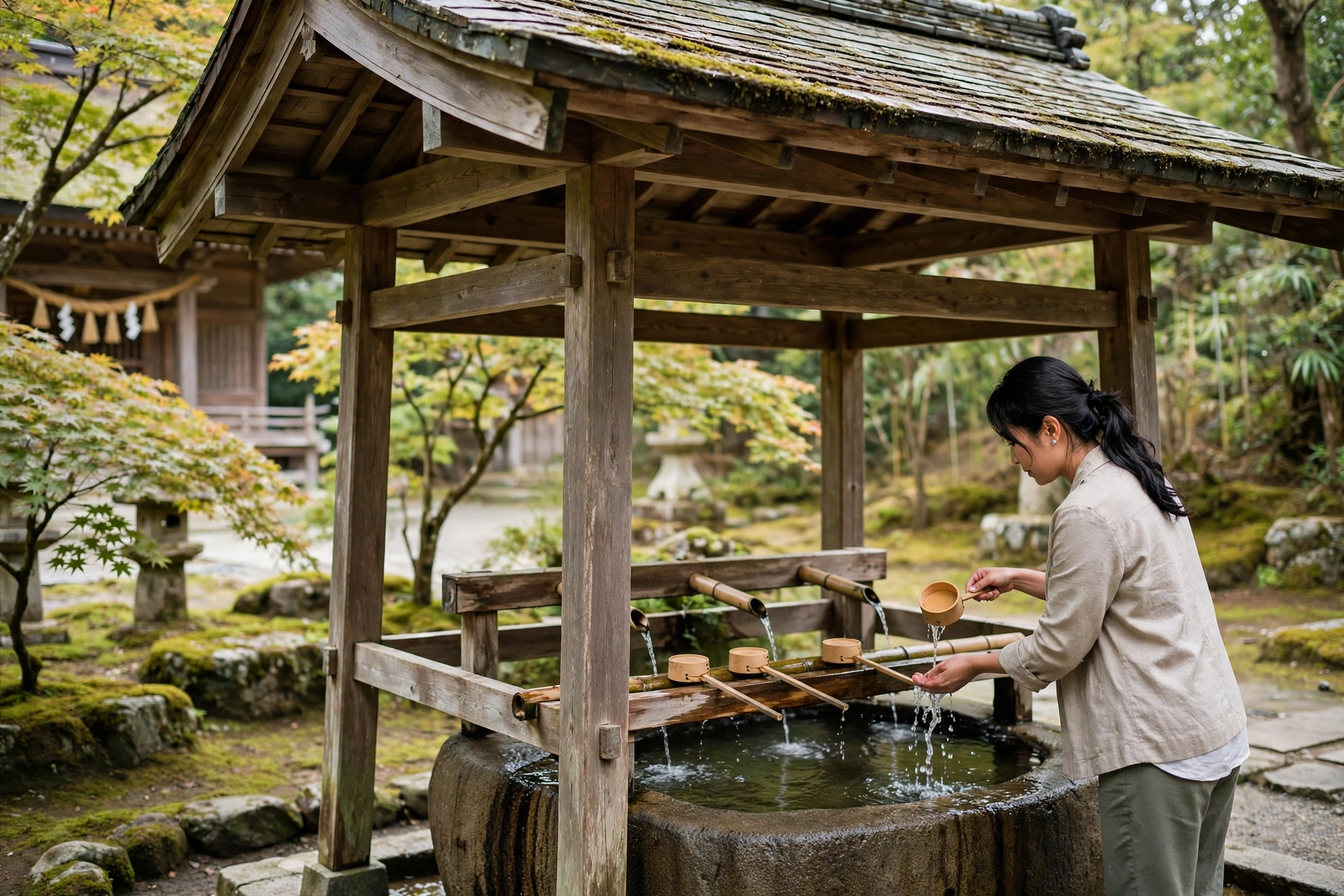
Temples & Shrines
Bow at the gate, wash your hands, pray quietly — and check before you photograph inside. Shrines (Shinto) and temples (Buddhist) are living places of worship, not museums, and the visit has a shape to it. It takes a minute to learn, and doing it, even imperfectly, is part of the pleasure of being there.
At a shrine: bow once at the torii gate before you pass under it, and walk on the left or right side of the approach path, as the centre is traditionally left for the deity. At the water basin (temizuya), rinse your left hand, then your right, then pour a little water into your left palm to rinse your mouth, and rinse your left hand once more. At the hall, place a coin gently in the offering box — there is no set amount — and if there is a bell rope, shake it once or twice. Then pray in the shrine form: two bows, two claps, one bow. Bow deeply twice, clap twice at chest height, keep your palms together for a quiet moment, then bow once more. A few great shrines do it differently — Izumo Taisha, for example, uses four claps — so follow the signs where they differ.
At a temple: bow once at the gate, and again quietly before the main hall. Do not clap. Simply press your palms together and pray in silence. That difference — clapping at shrines, silent hands at temples — is the one most worth remembering. If you offer incense, light one stick (sometimes three), stand it in the sand of the burner, and fan the flame out with your hand — never blow it out with your breath.
Many temples and shrines do not allow photography inside the hall, and images of the principal Buddhist statue are very often forbidden altogether. Kyoto's temples are a good example: you may photograph the gardens freely at many of them, while the hall interior is strictly no-camera. Look for the signs, and if there is no sign, ask. The same goes for people: ask before photographing monks, shrine attendants, and worshippers.
- Speak quietly, do not touch statues or buildings, and take your hat off inside halls.
- Do not step over thresholds or onto tatami in areas that are not open.
- Admission fees apply at many temples and shrines; they help keep centuries-old buildings standing.
- At busy temples, shoes can all look alike in the shoe shelves — a bright peg or clip on your own pair makes them easy to find again.
On Trains & Buses
The quiet-car mindset: low voices, no phone calls, and your bag where it does not block anyone. Japan's trains are famously calm, and the calm is made by the passengers. It is easy to join.
A transport IC card makes all of this simpler. Visitors can buy a tourist IC card at the airport, or use the iPhone app version. A money note: physical cards are bought and topped up with cash only, while the phone version can be charged by credit card. Some private railways and subways now also accept a credit card tapped directly at the gate, but JR gates generally do not. Japan is comparatively safe, but as locals do, carry only a modest amount of cash.
- Keep your voice low. Conversation is fine — just at the volume of the people around you.
- Do not make phone calls on board. Keep your phone on silent, and let calls wait until you get off. Near priority seats, follow the announcements — on crowded trains you may be asked to switch the phone off.
- Use earphones or headphones for music and videos, at a volume that does not leak.
- Hold a backpack in front of you, or put it on the overhead rack. Keep big luggage out of the aisles, and use delivery services or station lockers in crowded places.
- Queue to the side of the doors and let everyone get off before you board.
- Priority seats are for elderly passengers, pregnant women, people with disabilities, and anyone who needs them more — offer yours without being asked.
- Eating a meal is normal on long-distance trains with seat tables, like the Shinkansen. On crowded commuter trains, it is not done.
- Taxis: the rear door opens and closes automatically, worked by the driver — do not pull it yourself. Sit in the back seat, and show your destination written down or on a map if that is easier. There is no tipping.
At the Table
No tipping, two small phrases, and a short list of chopstick don'ts — that is nearly all of it. Tipping is not customary in restaurants, taxis, or hotels, and leaving cash on the table will often confuse staff. The Japanese way to show gratitude is a word and a smile.
Before eating, say itadakimasu (I gratefully receive this). After the meal, say gochisosama deshita (thank you for the meal). In a group, wait until everyone's food has arrived. With shared dishes, use the serving chopsticks or the opposite end of your own, and ask before taking the last piece. Slurping noodles is fine and even appreciative, though you do not have to. Finish what you can, as leaving lots of food is frowned upon and restaurants generally do not wrap leftovers. Small bowls of rice and soup are meant to be lifted in one hand; large plates stay on the table. To call the staff, raise your hand and say sumimasen (excuse me) — it is the standard way.
For sushi, eat each piece in one bite if you can, and use soy sauce sparingly — a little on the topping, not a soak for the rice. If chopsticks are new to you, lacquered ones can be slippery: it is fine to ask for disposable wooden chopsticks, Waribashi o moraemasu ka? (May I have wooden chopsticks?).
- Do not stick chopsticks upright in a bowl of rice — this is how rice is offered to the dead.
- Do not pass food from your chopsticks to someone else's — it echoes a funeral rite. Put the food on a small plate instead.
- Do not spear food, point with your chopsticks, or dig through a shared dish hunting for the best piece.
- Rest chopsticks on the chopstick rest (hashioki), not across the bowl.
- Paying: take the bill to the register by the door, place cash on the small tray, and split evenly among friends (warikan) if you like. Small local places may still be cash-only. ATMs in convenience stores, such as Seven Bank, accept many overseas cards.
Onsen & Baths
Wash your whole body first — the bath is only for soaking. Japan's tourist organisation gives five golden rules: wash first, keep your towel out of the water, keep your hair out of the water, mind the tattoo rules, and relax.
Onsen and public baths (sento) are used naked, and the baths are usually separated by gender. Swimsuits are not worn — the rare exception is a mixed bath that provides special bathing wear. At the washing stations, sit on the stool and wash your whole body with soap, then rinse everything off, so everyone enters the shared water already clean. Step in slowly, as the water can be very hot, and just relax — the bath is not for swimming. Leave your small towel on the side or folded on your head, and tie long hair up. Cameras and phones are not used in the changing room or the bath area; this one is absolute.
Tattoos — check the place. Many onsen, bathhouses, pools and gyms have traditionally not admitted people with tattoos, but this is changing place by place: some now welcome everyone, some allow tattoos covered with a waterproof seal, and private bookable baths (kashikiriburo) sidestep the question entirely. There is no single rule, so check before you go. If bathing naked in company is not for you, many ryokan offer rooms with their own open-air bath.
Toilets
Free, clean, and full of buttons — here is how to read them. Public toilets at stations, parks, department stores and shopping centres are almost always free of charge, and almost always spotless. Toilet makers in Japan agreed in 2017 on one shared set of pictograms, so the symbols look the same whatever the brand.
The Stop button (often red or orange) is the one to know first: if water starts doing anything unexpected, press Stop. Only press the wash buttons while you are seated — standing up stops the spray. You may also find a button that plays the sound of running water; it is a privacy device, and does not flush anything.
In many public toilets there is also a call button for emergencies, for when someone feels ill or has fallen. The flush button is the round button above the paper holder, in a plain or cool colour, while the call button sits further back in a different shape (square or triangular) and a warm colour. If you press it by accident, staff will come — just apologise (sumimasen) and explain.
Japanese toilet paper is made to dissolve, so flush it down — do not put it in a bin. The small lidded box beside the toilet is only for sanitary products. Nothing else goes down: no pocket tissues, wet wipes, or paper towels. Older buildings still have the traditional squat toilet: the door sign washiki means squat type and yoshiki means the seated, Western type. For the squat toilet, face the raised, rounded hood at the front and squat low.
- Rear wash is marked with a bottom and a spray; front wash, for women, with a seated figure and a spray. Flush is a large or small swirl, a lever, a sensor, or automatic.
- Carry a small handkerchief or pocket hand towel — many toilets have no paper towels, and hand dryers are sometimes absent or switched off.
- Toilets are found at stations (sometimes inside the gates), department stores, parks, and many convenience stores. At a convenience store, a quick word to the staff and a small purchase is the courteous way.
- If the toilet has its own slippers at the door, change into them, and leave them inside when you come out.
Streets & Daily Life
Carry your rubbish, join the queue, and copy the people beside you. You will see very few public rubbish bins in Japan — and streets that are clean anyway, because everyone carries their rubbish with them. Carry a small bag in your daypack, emptied at your hotel or at a convenience-store bin. When you do find a bin, take a second to sort burnable, non-burnable, and bottles and cans.
In shops and supermarkets, always pay before you open anything: opening a package or eating and drinking before the till is treated as theft, however innocent the intention. Eating while walking is generally avoided; eat standing by the shop or find a bench. A drink from a vending machine, finished on the spot, is completely normal.
- Smoking only in marked areas. Smoking while walking is prohibited in many cities and can bring a fine, and station districts often ban street smoking altogether. Never drop cigarette ends on the ground.
- Queues are real — at platform doors, bus stops, tills, even elevators. Join the end of the line.
- Escalators: in Tokyo people stand on the left, in Osaka on the right, and more railways now ask everyone to stand still on both sides. Stand where the person in front of you stands.
- Ask before photographs of people — a smile, a gesture, and shashin ii desu ka? (may I take a photo?) will almost always get a yes. Never wander into a garden, field, or driveway for a better angle.
- Public displays of affection are kept modest in Japan; a quieter style fits in more easily.
- Some places ask for a little more than these national basics, because people actually live inside the scenery. Villages such as Shirakawa-go keep their own requests about parking, fire, and quiet evenings — this site also has a Shirakawa-go manners page, so please read it before you go.
Homes & Ryokan
Shoes off at the step, slippers on — and slippers off again on tatami. Choose shoes you can slip on and off easily. And be on time: trains run to the minute, and inns keep check-in and meal times just as strictly. If you will be late, phone ahead.
At the entrance (genkan), step out of your shoes on the lower floor and step up in your socks — never onto the raised floor in shoes, and never back down onto the entrance floor in slippers. Turn your shoes to face the door and set them neatly to the side. A quiet ojamashimasu (sorry to intrude) is the classic greeting at a home. Indoor slippers will be waiting; wear them on wooden floors and in corridors. On tatami mats, slippers come off — tatami is walked on in socks or bare feet only, in homes, ryokan and temples alike.
The toilet has its own slippers: change into them at the toilet door, and remember to change back when you come out. At a ryokan, the yukata (a light cotton robe) in your room can be worn around the inn and to the baths. Wear it left side over right — right-over-left is reserved for the dead, and staff will kindly fix it if you get it backwards. If anything is unclear, just ask.
Staying Connected
Sort your connection before you fly — free Wi-Fi exists, but do not build your trip on it. You will find free Wi-Fi at airports, major stations, convenience stores and many hotels, and some cities and trains offer it too. It is useful, but patchy: it may need a registration page, drop in crowded places, and vanish exactly when you need a map most.
- eSIM (easiest if your phone supports it): buy a Japan data plan online before departure and activate it when you land. Check that your phone is SIM-unlocked and eSIM-compatible first.
- Pocket Wi-Fi (best for groups): a small rental router collected at the airport. One device connects the whole family — but numbers are limited, so book early in busy seasons, and remember it is one more battery to charge.
- A physical SIM card: sold at airports and electronics shops; needs a SIM-unlocked phone and a few minutes of setup.
- Before you leave home, download offline maps and an offline translation pack, and save your hotel's name and address in Japanese as a screenshot.
- On public free Wi-Fi, keep it light: maps and messages, yes; banking and important passwords are better on your own connection. Prices and plans change quickly, so compare current offers shortly before your trip.